A Home Swimmer’s Guide to Progressive Resistance Training in the Pool
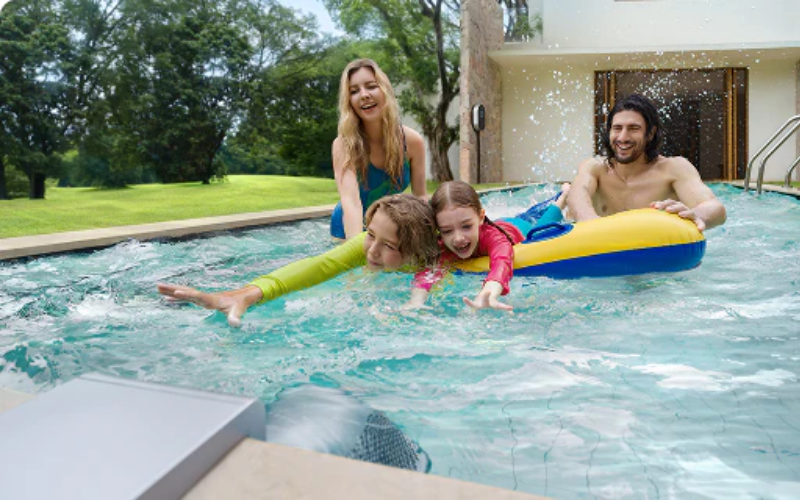
Progressive resistance training is not limited to the gym.
You can apply the same basic idea in the pool. Start with a level of resistance that you can control. Then increase the challenge gradually as your fitness and technique improve.
A swim current makes this easy to manage at home.
Instead of swimming faster over a fixed distance, you can increase the strength of the water moving toward you. This gives you a simple way to make workouts harder without needing a longer pool.
The key is progression. More resistance is useful only when you can still swim with good technique.
Begin With a Comfortable Baseline
Before increasing resistance, find a current that feels sustainable.
You should be able to swim for several minutes without losing body position.
Your breathing should remain controlled. Your stroke should feel natural. You should not need to sprint just to stay in place.
This is your baseline.
For many swimmers, the first goal is not to make this setting harder. It is to become more efficient at the same resistance.
Try to maintain a steady position with less unnecessary movement.
Once that feels comfortable, you can begin adding small challenges.
Increase One Variable at a Time
There are several ways to make a current workout harder.
You can increase resistance.
You can swim for longer.
You can add more intervals.
You can shorten recovery periods.
Do not change everything at once.
For example, if you normally swim for 20 minutes at a moderate current, you might increase the current slightly while keeping the same workout length.
Another week, you might keep the current unchanged and add five minutes.
This makes progress easier to track.
It also helps you understand which change is creating the extra challenge.
Use Technique as Your Limit
Your stroke should decide how much resistance is appropriate.
A stronger current often causes swimmers to increase stroke rate. That is normal.
However, problems begin when the stroke becomes rushed.
Watch for a shortened pull, dropped hips, uncontrolled kicking, or poor breathing.
These are signs that the current may be too strong.
Reducing resistance is not a failure.
It allows you to train at a level where the movement is still useful.
Progressive training works best when technique improves alongside fitness.
Build Resistance With Short Intervals
You do not need to increase the current for an entire workout.
Short intervals are a safer way to introduce higher resistance.
Try swimming at your normal current for five minutes.
Then increase the resistance for 30 seconds.
Return to your normal setting for one minute.
Repeat this four to six times.
As the workout becomes easier, extend the hard intervals to 45 seconds or one minute.
This lets your body adapt gradually.
It also gives you experience holding good technique against stronger water.
Progress From Short Efforts to Longer Sets
Over time, the goal is not simply to survive a powerful current for a few seconds.
You want to maintain control for longer periods.
Once one-minute efforts feel manageable, try two-minute blocks.
Later, you might complete five minutes at a stronger resistance followed by two minutes of easier swimming.
This type of progression is useful for endurance.
It teaches you to maintain a stable stroke even as fatigue increases.
The change should happen gradually over several sessions.
Keep Easy Sessions in the Plan
More resistance does not need to appear in every workout.
Easy swimming is still valuable.
Lower-current sessions give you time to focus on stroke length, breathing, and body alignment.
They can also help you recover between harder training days.
A simple weekly schedule might include one technique session, one steady endurance swim, and one interval session.
This creates progression without turning every workout into a maximum-effort test.
Consistency is more important than constantly chasing harder settings.
Choose Enough Training Range for Future Progress
If resistance swimming becomes a regular part of your routine, the adjustment range of the system matters.
A useful iGarden swim jet should give you enough control to move between easy technique work, steady endurance swimming, and harder interval sessions.
For regular swimmers who want room to progress, the P200 can be worth considering.
It provides a middle ground for swimmers who have moved beyond light recreational resistance but do not need the strongest setting for every session.
The P230 is more relevant for advanced swimmers who expect to use higher resistance regularly.
However, choosing a higher-performance model does not mean training at maximum output every day.
The additional range is most useful when it gives you room to progress over time.
Use a Simple Four-Week Progression
A basic training block can make progression easier to manage.
During the first week, establish your baseline. Complete several steady sessions at a current you can control.
In week two, add four to six short high-resistance intervals.
During week three, extend those intervals slightly while keeping the recovery periods comfortable.
In week four, reduce the intensity and focus on technique.
After that, begin another training block at a slightly higher baseline if your stroke remains strong.
This approach gives the body time to adapt.
It also prevents every week from becoming harder than the one before.
Watch Your Body Position as Resistance Rises
Higher resistance often exposes weaknesses.
Your head may lift when breathing.
Your hips may drop.
Your kick may become too aggressive.
You may also begin crossing the center line with your hands.
A current provides immediate feedback because these mistakes often cause you to drift.
Use that feedback.
If you suddenly move backward at a higher setting, do not only try to pull harder.
Check your alignment first.
Sometimes a small technique correction is enough to hold position more efficiently.
Measure Progress Beyond Current Strength
A higher setting is only one sign of improvement.
You may also notice that you can swim longer at the same resistance.
Your stroke rate may become more stable.
You may recover faster between intervals.
You may be able to hold a better body position with less kicking.
These are all useful forms of progress.
In fact, becoming more efficient at the same current can be more valuable than simply increasing resistance.
Build Strength Without Losing Control
Progressive resistance training works because the challenge grows gradually.
The pool should follow the same principle.
Start with a current that supports good movement. Add resistance in small steps. Use short intervals before longer hard efforts. Keep easy sessions in the schedule.
Most importantly, let technique determine how quickly you progress.
The goal is not to reach the strongest current as soon as possible.
It is to become stronger, more efficient, and more comfortable against resistance over time.
With a controllable swim current and a simple progression plan, a home pool can support months or years of increasingly challenging training.